Labels

DESIGN STUDIES (14) LECTURES (6) PROJECTS (12)
Showing posts with label DESIGN STUDIES. Show all posts

Thursday, 14 April 2011

ACTIVITY 5B- SUMMER PLANS!

As I've got many months off from university during the summer holidays I am giving myself certain goals which I will do throughout the holidays such as making connections, organising my work and broadening my knowledge by reading more.

BOOKS-

1.THE DESIGN OF EVERYDAY THINGS BY DON NORMAN

This book  interests me as it reveals how smart design of everyday things is a powerful indication on how and why some products satisfy customers while others only frustrate people.
 I feel that this could help me in the future when designing interior spaces as I need to think more about what the client requires and how to design something that will fulfil their needs and wants. Whilst designing something functional and of good design.


2.BLINK: THE POWER OF THINKING WITHOUT THINKING BY MALCOLM GLADWELL

After reading 'The Tipping Point' by Malcolm Gladwell last semester I am going to read this book as I was inspired and interested in his other book. This will definitely be a book which I will read while lounging around on holiday.

This book is about the power of the sub-conscious mind and how decisions made very quickly almost by what your instincts tell you can be as good as taking ages to decide on something.


3.THE TEN FACES OF INNOVATION: STRATEGIES FOR HEIGHTENING CREATIVITY BY TOM KELLEY

Throughout second year and probably into my working life,  team work will play a big part in what I do. This book explains how both creativity and business innovation is needed in every business. It also highlights the different stages in which people play to get a better and faster result.


4.FASCINATE: YOUR 7 TRIGGERS TO PERSUASION AND CAPTIVATION BY SALL HOGSHEAD

What triggers fascination and how do companies, people and ideas put those triggers to use? This book explains how our fascination shapes our ideas, opinions and relationships and how to use this to our advantage.

I feel that this may help me in the future to understand and use  in a working situation.


5.THE LAYOUT LOOK BOOK BY CHRISTIAN CAMPOS

This book looks at different layout techniques that could be used for any design background from professionals to amateurs at any time in the design process.

Presentation boards are a huge part of my course at the moment and I feel that this book would help me understand how to layout my presentations better it could also maybe help thinking about how the layout of certain interiors could be achieved to a better level.


BLOG-

1.During the holidays I will create a delicious account. This will help me to organise all my bookmarks on the web so that I am able to find what I am looking for quicker and easier. As I use both a laptop and Imac this will be very beneficial to me as sometimes I'm unsure of where my bookmarked stuff is.

2. I will also join Twitter. I feel that this would be a good way to make connections with people from design backgrounds such as interior designers and architects.


3. Blog more about interesting design / architecture. I feel that recently with the end of a huge project looming I have been unable to blog as much as I would have liked so in the holidays I will read more articles to do with design and things which interest me.

4. As I have hardly changed my blog layout I will also do this in the summer to give it a fresh and more interesting display.

5. Lastly I will sort out my tags on my blog so that they are easy to read and more organised for both me and the viewer.


CONNECTIONS-

1. LORIN EDGAR

After my gap year to South Africa I have slowly lost contact with Lorin who I worked beside as an art teacher for 8 months. She was a very inspirational and interesting character so I hope by emailing her that I will be able to stay in contact with her again and find out what she is doing as I haven't spoken to her in around 4 years.

2. GAIL KELLY

Gail is an undergraduate graphic designer who used to attend DOJCAD. She is currently working in Glasgow as a Graphic Designer I will hopefully meet up with her in the holidays for a chat.

3. LEILA KALBASSI

Leila is the scenic artist at the REP theatre in Dundee. After doing work experience with her 2 years ago I am still interested in this field so will maybe try to contact her through email to see if she has any work experience over the holidays.

4. BLACK ANDREW DESIGN LTD.

5. BATTLEDOWN STUDIO NATURAL ARCHITECTURE

As the holidays are fast approaching I am wanting to get some work experience under my belt so I am hoping to contact different architecture firms (such as the ones above) to ask for work experience. Mainly I will be writing to them even if i get one acceptance then I will gain more knowledge in my field of work.  


ASSIGNMENT 5A- PLANNING FOR THE FUTURE

During last semester I started to investigate into the relationship between children and the world of advertising. First referring to the book ‘The Tipping Point’ by Malcolm Gladwell I looked at the stickiness factor, which looks at how brands such as Sesame Street become so popular that they “tip” and become sticky. Everyday without realising it we are surrounded (some could say suffocated) with adverts. Everywhere we go , everything we do advertisement is all around us from television and radio adverts to billboards and shop windows we are sometimes unknowingly being subjected to buy, buy, buy! During a university lecture by Jonathan Baldwin I watched a panorama programme which highlights the issue of how more than ever advertising is having an impact on children. This programme opens your eyes, it was astonishing to watch both children and parents buying only branded clothing as they felt pressure to fit in with others . I started to wonder if family upbringing or who your circle of friends are has a large part to play in this and if advertisement even has a part to play.  
For my proposal I want to investigate how much affect advertisement has on children and if this has an impact on what parents are buying their children. This would be an interesting subject as we are unsure if children even understand what adverts are or if they even pay any notice when adverts are playing in between their favourite cartoons. To get a successful outcome I need to think about researching into families from different backgrounds, ages and sexes so that my findings are of the best quality. I would like to further my research by using certain research service tools to find out more about this subject. Referring back to ‘Design Methods’ by John Chris Jones I can think about the most relevant design methods to explore my subject further. 
Firstly I would like to find out how children interact with television adverts therefore I feel that an observation would be a worthwhile exercise. I could observe how children interact with television advertisement in their natural environment. A nursery or school scene would probably be best as I could get a large group of children together at the same time without them noticing anything unusual. In a family living area the child may feel that I was doing something and therefore I wouldn’t get an accurate result. Where as in a school or nursery the children would be used to different people and therefore be more comfortable in that surrounding. I would look out for signs such as how much attention do they pay when watching adverts? What are they drawn to? Does sound, colour and imagery play any part to what they watch? 
The size of the group would probably be around 15-20 children at a time with 3 or 4 individuals watching them. Although this may be a problem as it is hard to track five children at one time to see what they are watching so to get a more accurate reading I could install a camera on top of the television monitor which could track eye contact and see what they are watching although this may be more costly. This would be quite a fast process and overall to get an adequate result I would watch around 15 children. To track results I would collect results and form them into a pie chart so that they are easy to read.
Another valuable research tool to find out how much branding has an impact on children I could do a visual analysis of photographs.  I would show children individually images of branded toys, food,etc without any text and see how good children are at recognising different logo’s to find out how exposed they are to branding. I could also let them listen to different jingles from adverts to see how in tune they are with advertisement. This would be an exciting process for them as they are shown different images and sounds which would be played like a game. In between all this a casual interview could take place asking children where they know the logo from? Have they been bought anything with that logo on? What do they like about the logo/jingle? 
I would approach around 7 different children aged between 5-10 to get an accurate result. The experiment would last for around 5-10 minutes so that children are alert and interacting with you. This would take place in an environment where children are such as at school or youth club so there is a separate room which could be organised to do the experiment. The streets wouldn’t be a suitable place as there are too many distractions also if a jingle is played there needs to be peace and quiet for the children to listen to it and concentrate. To record results I would fill in a questionnaire as I was doing the experiment which would have all the relevant questions that i would ask during the visual analysis and interview. As the children are so young they would be unable to fill in a questionnaire themselves. 
I feel that mind mapping wouldn’t be a worth while research method as the target group is children this wouldn’t be exciting enough for them to want to participate in therefore they will loose interest and an accurate result may not be shown. One to one interaction and actually observing the children is the bast way to find out if adverts are doing what they should and selling a product to its target market. 
These research methods will get a clearer indication  to what children are watching and what makes an advert interesting. Also finding out how exposed children are to brands and adverts to see how good the child's memory is. This gives an insight into if children understand what logos are and if they have an impact on their lives.


Monday, 21 March 2011

ASSIGNMENT 4: HOW DO SALES PEOPLE INFLUENCE PURCHASES?

For this part in the assignment I have to interview three to four individuals and ask them how sales people influence purchases? As I work in sales this question really interests me as I want to see if the answers reflect what I am taught to do in a day to day basis at work. I want to find out if our environment has any impact on what we buy from the interiors of how a shop is laid out to how people are approached by customers. I firstly did a mind map to think of what questions to ask. As the interview has to be in a semi-structured format I'm planning some of the questions and areas I want to explore but keeping my questions quite general. Using the service prototype tool I will then observe and interact in a shopping situation and observe how people interact with sales people.

Brainstorming questions to ask (above)

ACTIVITY 4C

Recently I have been interviewing people asking them how sales people influence purchases? Over all of the interviews one thing cropped up every time- the sales people need to be knowledgeable about what they are selling to the consumer and also take an interest in what the customer is wanting if not the customer might not take what they are saying into consideration. Many are often put off buying when they feel pressured into a product by the sales person. One interviewee said  "some sales people are just trying to reach their sales target for the day and really don't care for what the customer is wanting, they prefer to sell more expensive items which they might not want." This may be true in some companies as pressure to make sales is high but sales people need to act in a approachable and friendly manner or they may not get the sale as customers are put off with feeling forced into a sale. Two of the interviewee's work in sales and both are aware when someone is just trying to get money in the till which puts them off as they know  how the sales business works.

When asked "what influences you when out shopping?" The majority are influenced by price, advertisement and special promotions. This maybe because it is what everyone else is into such as a fashion so many may want to fit in with society. When looking at the price of something most people look for a good deal or bargain as they may feel that they have spent their money wisely as it could have cost them much more a couple of weeks back so there is a feeling of achievement.


When researching this further I found an interesting website that found that designing a website into categories influences people to impulse buy when shopping online so maybe this works in shops as well to sell more as people are aware of different things to buy such as if you were looking to buy a bikini for their holiday, you go into a shop to buy that but then beside it are sun glasses- you need those too (even though that isn't what you originally went for) so you may as well get them too. Sales people could also use this to get more sales by asking customers if they have certain items which relates to what they are buying.

Sales people need to be enthusiastic and believable about what they are selling to show the customer that they have a common interest in what they are selling to you. One interviewee described it as someone who is " on the same wave length as them." This is so that the customer can relate to the seller therefore feels more at ease to what they are buying.

As I work in sales I was able to watch some of the people without them assuming that I was analysing what they were doing, how they were interacting with the customers, etc. This is a research technique called prototyping which is used to observe a service by watching the interaction between the user of the service in the place, situation and condition of where the service actually exist. When analysing the situation I became aware that one person who specialises in customer service would approach certain customers but not others. When I interviewed her afterwards I asked her what her duties where when on customer service? She replied "to approach customers and either say hello or can I help you with anything?" I asked her why she didn't approach everyone and her reasons were that there are 3 different types of customers ones who are browsing but not buying, one who is looking for something in particular and one who is unsure of what they are wanting to buy. I feel that she may not have approached everyone as some people looked as if they were just browsing or their body language showed that they don't want to be approached. I feel that as a sales person you can usually sense if the customer wants to be approached or wants to be left alone to shop. One customer approached the employee and asked for a shoe in a different size which wasn't displayed, the employee then went up to the stock room to look for a different size, as there were no more in that style the employee offered an alternative shoe which she described as being " very fashionable and new to the summer collection" This makes the customer feel as if the shoes are very now in the fashion world and will be in trend for the summer months. This shows that the colleague is very knowledgeable and knows what fashions are on trend. The customer then bought these shoes- this shows that sales assistants can influence purchases as they have more knowledgeable in the products.

Overall I feel that sales people can influence customers quite a lot but the sales person must be knowledgeable about what they are selling, friendly and relatable to their target market.

Monday, 7 March 2011

ASSIGNMENT 3C- OBSERVE & RECORD!

PRIMARY SOURCE

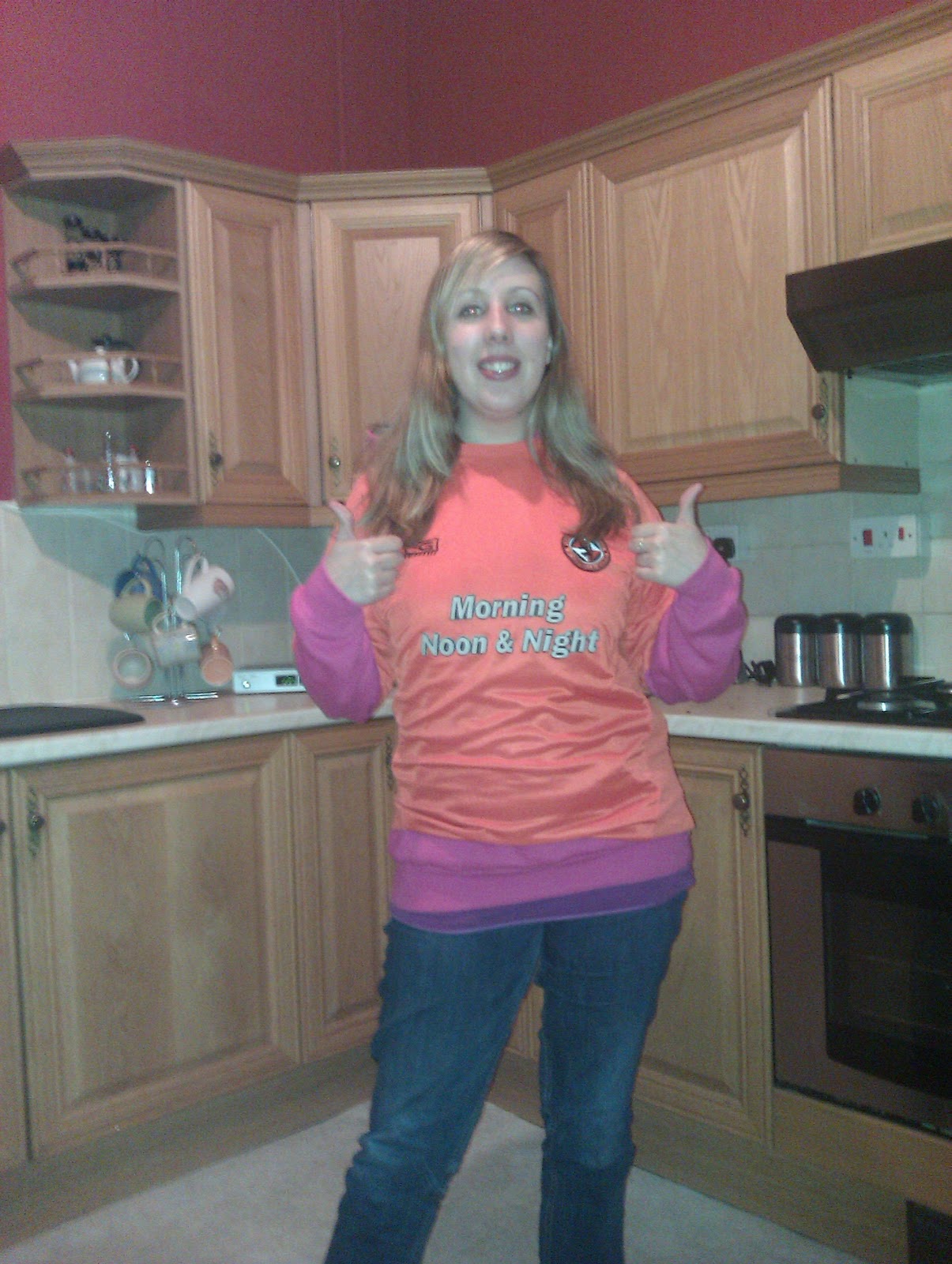
For this part of the assignment I had to firstly observe people in a situation which I felt uncomfortable in. I decided to go to the Dundee United Vs St Johnstone football match. Then I was to try and engage in my surroundings as much as possible and finally record my findings. Here is what I found out!

Me just before the game! (Borrowed my boyfriends Dundee United strip so I blended in with the crowd)

As I approached St Johnstone football grounds I started to follow the swarm of people walking towards it as I was unsure of where to get in- there was no clear entrance until I went round part of the stadium then there were two entrances one for the home team supporters and one for away supporters, as I was with my boyfriend who is a massive Dundee United supporter we went through the away entrance so joined the small Que to get in. There was a strong police presence outside the stadium with a couple of police vans parked outside and I could hear the barking of the police dogs who I presumed were inside the vans.  There were also many stewards who were organising the crowds to make sure that the number of people queuing stayed down. The crowds were very lively, friendly and up beat- singing team songs- one person would start singing and within a couple of seconds everyone was singing along. The majority of people wore the team colours- tangerine and black for Dundee United and blue and white for St Johnstone so it was easy to pick out who supporter which team. As I approached the entrance it was a more unfriendly atmosphere with a metal turnstile in front of me and a staff member who only asked "how many tickets?" No "hello" or "thank you" just the exchange of money and then I walked through the small turnstile which felt more like a prison entrance than a football match.

 As I walked out into the stadium there was a great atmosphere in the air. I was able to sit anywhere so chose to sit in a crowded area so that I was able to observe as much as possible. The crowd was a mixture of ages from young children to older people and although there were some women it was mainly male dominant who were in small groups of friends or families. This was quiet a sociable space. As the game started I was amazed how competitive the atmosphere was when certain teams did bad, people would boo- this reminded me of going to the pantomime. Throughout the game there were many people shouting and swearing (mainly at the referee). After discussing with other people who have been to a football match they feel that it is maybe a stress relief for some people as they are able to shout in this situation. It became quite unpleasant at times but at times when the supporters would start singing there was a feeling of belonging and that people share the same passion for the teams so have something in common with each other. The stadium was divided with supporters to the right was the St Johnstone supporters who were in the bigger part of the stadium and to my right was the family area which was nearly empty. No one was in the stadium opposite me, I presume this is so that everyone is together and not scattered and to create more of an atmosphere for the crowd, also maybe to keep it safer as there is more staff in one areas and they don't need to scatter as much.
There were some rules such as:

  • No smoking
  • No alcohol
  • No sharp objects
  • Bag searches would take place
  • Do not climb signs ( on the barriers to the pitch)
Although there weren't many rules I felt that I should react in a certain way in certain situations such as when everyone else stood up because one team nearly scored then I should do the same. I feel that this was spur of the moment reaction to my surroundings so that I didn't feel out of place or different. The police at all times would be walking around just outside the pitch watching the supporters and making sure that no trouble was started. If there was a large group of people singing or making loads of noise they would stop and watch to make sure no one was out of order. There were also two stewards who stand at each walkway around the stadium, I presume they are there in case any supporters need help or for security reasons. The fans body language was quiet open and friendly at times although when the game wasn't going too well they were more closed and angry- arms folded, etc.


As half time approached many people went a couple of minutes before half time to get food and drink so there were no ques. Everyone seemed to stand up at half time and talk amongst themselves. There were many services such as a snack bar which sold hot drinks and pies and also a half time draw which was advertised on your way in to the game as well as programme sellers. I would have presumed that most people were from a middle class background and either from Dundee or Perth as that was where the teams are from but I soon realised that this wasn't the case! A man who was sitting beside my boyfriend started chatting away to us. He had a strong foreign accent, in his early thirties and looked like he looked after himself. We soon found out that he is an international football player and plays for both Holland and Ajax. I was quite surprised by this as this was just a friendly game at my local football grounds - why would he be watching this game? He later told us that he was here to watch his friend play who was recently bought over by Dundee United from Ajax. This totally changed my perceptions of the supporters! As the game came to a close many people left just before the final whistle- probably to get there cars out before the rush of people. When leaving there was a real feeling of frustration as the game ended 0 - 0. It was also a lot quieter, a feeling of failure...

SECONDARY SOURCE

For the next part of my assignment I was to observe a situation which we encounter on a daily basis. I decided to observe the bus station. As I got from Perth to Dundee and back every day to get to university this was quite easy for me to observe. The bus station offers many services such as a small newsagents, cafe (which serves hot and cold food and drinks to take away or stay in) and the ticket office. Some services which I have never realised such as the information point and travel finder- although I go straight past it every day I've never actually noticed that which sounds quite bad since I've been getting the bus for the last two years! I also noticed that the toilets charge you 20p- which to me sounds a bit crazy but I'm sure it probably makes enough money to maintain it. There is so much advertisment around such as a stand full of leaflets from cinema timings to adventure parks. Also there is a billboard outside behind the stances probably there to entice people to buy into their product as you wait for the bus to come. Even on the sides of buses advertising anything from films, cheaper bus tickets, to promoting breast feeding. 

The people who travel from bus are mainly from middle class backgrounds. There are quite a lot of people in there 20's and the elderly. This is probably because most working class people have cars and also it is only 4pm so they won't be getting out of work until around 5pm. There is a calming atmosphere and although most people have a friendly appearance and a casual open stance they seem emerced in either their iPods or mobile phones. Quite a lot of men are reading the paper, one is doing a crossword- maybe he is quite knowledgeable? Although the seats are in clusters of three only the two end ones are ever used- Thinking about this it maybe quite an unfriendly atmosphere or maybe its more about personal space, how close is too close to someone you don't know? The bus station is designed in such a way that there are three seats in front of the automatic doors and three seats away from them- majority of people sit at the seats away from the door in winter as it brings a chilling breeze.

 When someone walks past them people usually watch them for a couple of seconds- looking them up and down and then get back to what they were originally doing. One woman who catches my eye has a stricking appearance with a tartan scarf on and also a small scottie dog beside her who also has a tartan jacket on. I would think that she is  an animal lover and is probably proud of her Scottish heritage. There is also a man who has a red and white Amsterdam hat on- is he from there? has he visited there? Or maybe it was a present from someone? I think he was from Amsterdam he also had red and white trainers and scarf, maybe he likes matching clothes but I doubt it. There are a lot of different cultures that pass through Dundee and that has been highlighted when doing this excercise so this is maybe why there is an information and travel finder area.. 

 The staff workers are very friendly walking to and from the buses with a spring in their step. There is also one member of staff working there with a clip board and pen he probably makes sure that all buses are on time, I think it's probably only the mega bus's and City Link coaches as he always seems to stand around there. The only time individuals interact with the staff is if they have a problem and are worried about which bus to take usually the staff act in a sympathetic way to put customers at ease. There always seems to be a que at the blairgowrie stance but no others, I'm unsure why- might be because most people come from there into Dundee or maybe the buses aren't as frequent.


As a bus arrives most people walk out casually to the stance which it is at and wait in an untidy que until the driver is ready to board the bus then the ques become more sorted. When walking on the bus everyone sits in seats away from one another it is only once these seats are all filled that people have to sit beside each other, although many people put their bags or jackets beside the seat so that no one sits there. I have also noticed that certain individuals sit in the same seat day in day out. Probably more of a habit and where they feel most comfortable.
 Here are some of the rules which I encountered when at the bus station:
  • Do not proceed beyond the yellow line- which was around the kerb of the stances so that no one is in danger when buses park.
  • Keep Clear- beside automatic doors- if not kept clear a noise is made by the door to alert people to move.
  • No smoking
You are also made aware that there are CCTV cameras in the bus station. After discussing my findings with other people they all seem to have the same kind of observations as me. Observing how people need there own space and feel annoyed if someone was to sit beside them if there are other free seats around. I feel that in the future through the use of enthology I could use this research tool to understand the clients needs who I am designing for.


Tuesday, 22 February 2011

ASSIGNMENT 3- TIME TO OBSERVE!

For the next part in my assignment I have really been taken out of my comfort zone! I must observe how people behave in places which I would feel uncomfortable in. I have chosen to go to a football match Dundee United vs St Johnstone. My first thought were PANIC! Do I order tickets? Do I just go and buy tickets there? It's tonight so if I order tickets how do I get them?? What do I wear? How should I act? As you can tell I'm a bit of a worrier! Although I'm going with my boyfriend who is a huge Dundee United fan (and has been to hundreds of football games) he isn't allowed to help me find my way around so that I will observe more.

For my second place to observe I have decided to view people in a bus station. As I go from Perth to Dundee and back everyday to get to university I've never observed the people so this will probably be quite eye opening for me as I'm not used to observing anyone, I'm usually listening to music and waiting for time to go by!

 Although I'm panicking a bit this could be quite an interesting assignment. Snooping on people...watching what their habits are.....seeing how I feel in certain situations. Might be quite fun!

ASSIGNMENT 3B- ETHNOGRAPHY

After reading the passage The Ethnography Primer I got a better grasp with what ethnography is all about. Ethnography is a research tool which is used for designers to get a greater understanding of who they are designing for and what the main requirements are by immersing themselves in other peoples environments and observing their habits, relationships with the space/product and patterns in behaviour. Observing reality is better than interviewing someone about what they do in certain situations as they probably don't think about certain things which could be key to your research. Therefore observing people when they are oblivious is the key to getting the best results.

This technique is used so that designers can design great design that connects with the audience and it's function is used to its full potential.

ASSIGNMENT 3A- SERVICE DESIGN

For this assignment I firstly took a look into service design and how this could relate to my past projects. Many of the service design tools could be used for my discipline as interior design is about designing certain spaces for a service or function. Here are a couple of examples which could or have helped me during past projects:
  •  STORYBOARD TOOL- It is simply described as showing "the manifestation of every touchpoint and the relationships between them and the user in the creation of the experience".
 I used this service tool in my furniture project. As I designed a multi functional furniture unit for my presentation I sketched different ways in which the unit could be used so therefore the viewer will be able to understand the different ways in which the furniture could be situated. Also an instruction manual was made by another member of the team which explained how the flat pack furniture was to be assembled in a story board senario so that the user has step by step instructions to follow.

  • GROUP SKETCHING- " It is used during the co-design sessions in order to share the insights inside the team.."
I feel that this could have been used in my juteopolis project to help plan out what my group wanted in our exhibition space. It probably would have got design ideas flowing more and resulting in a better understanding of what others thoughts were and bouncing off of each others ideas.

The trainride tool explains that by writing down certain touch points to a specific journey or experience that this gives a better visual observation to what happens at certain points. This tool could have helped with my rehabilitation unit that I designed in first year. As part of it I visiting the brain injury rehabilitation centre as I was to observe the space in which the patients lived in and how they interacted with it. I feel that if I used this tool I could have got a more effective outlook into how the space is used therefore coming up with a more user friendly atmosphere and documenting my findings in a more effective and quicker way.

Monday, 21 February 2011

ASSIGNMENT 2: WHAT IMAGES MEAN

ASSIGNMENT 2A

In this assignment we were asked to firstly read The Image by Roland Barthes. As stated by Jonathan this was quite hard to understand so I found it easier to understand with the notes which were provided. Polysemy is basically something which has multiple meanings, such as images- they can mean different things to different people and in different situations. Say text was added to an image- you would probably have a different more focused meaning to the image therefore having a better understanding of what the image was trying to say in it. In The Image by Roland Barthes he suggests that there are three types of messages: the linguistic message, the coded message and the non-encoded message.


  • Linguistic message- An image with text which gives a greater understanding of what the image is trying to tell the viewer by using text.
  • The coded message- Symbolic meaning which is only understood to those who have certain cultural knowledge.
  • The non-encoded message- everyone can understand just by viewing an image.
In this assignment I will get a greater understanding of what this theory is about and put it into action to see if it really works.

Firstly I got into a group with 3 other individuals to discuss the chapter which we read and like most others in my group we found this hard to understand but discussing it helped a great deal. We also discussed how this theory could work within our discipline- interior design. I feel that as we are creating different environments to cater for different individuals needs that interior designers have to incorporate this into the work to succeed in designing a relevant space.

 ASSIGNMENT 2B

For my groups experiment we firstly selected 3 images:


ASSIGNMENT 2C

We then asked a selection of people what there thoughts were towards the images. Many just described what they thought was going on in the images such as the fire image which could be a camp fire whilst others had a more symbolic approach to the images- seeing the fire as a sign of danger. After they had analysed all the images they were then to make up a story which links all the images together, they were allowed to put the images in their own sequence. Quite a few of the volunteers came up with a similar story- looking at the hotness and coldness of the images and describing it to the weather. After we got around 7 peoples stories we then selected one story which to take forward into our next stage of the experiment. This was the one which was chosen-
 
"flames being the summer months, tunnel showing timeline between the summer to the picture of the winter pond ie. winter months".

ASSIGNMENT 2D

We then had to pick a fourth image to add to our others and the trick was trying to get people to make up similar or the same stories as the one above.


This task ended up being quite challenging and although many people were thinking about the seasons, many were getting confused when shown the spiral walkway image as they were unsure of what it was, so their stories ended up being quite different to what we were hoping for.

ASSIGNMENT 2E

Next we were to add text to one of the images. For this we decided to add the words "the cycle" to the spiral walkway image to see if the volunteers would understand this image better. This seemed to work very well and the majority of people got very similar stories such as this one:

"This reminds me of how the seasons are just a continuous cycle ranging from the very warm to the very cold. From the heat of the summer to the cold frost in winter time."

I feel that our experiment has agreed with Barthes as many people were coming up with different stories before the text was put in. Once the text was put in place this helped people coming up with similar if not the same stories. I feel that my understanding of polysemy has improved by doing this experiment as I now understand how we are very influenced by text when it is added to an image to explain something in the right context and also how different people have different opinions when looking at an image it is only when you add more meaning such as text that the meaning is "fixed" to one particular purpose.

Wednesday, 15 December 2010

ASSIGNMENT 4 READING & REVIEWING

Assignment 4: Reading & Reviewing
Activity 4A

BOOK- DESIGN METHODS BY JOHN CHRIS JONES
Design Methods by John Chris Jones firstly evaluates traditional methods such as design by drawing and looks into how today's designers adequately address the difficulties within today's demands. Part two of this book addresses 35 new methods that have been used to support both designers and planners. Jones focuses on different methods which he has chosen personally by reliable sources to make it easier for designers to find a method to suit specific design situations. The authors goal is to improve the quality of design by responding to the rapid change in design tasks and to give readers a broader view of design.
Jones reviews the strengths and weaknesses of all the design methods to this book which gives a bias opinion to the reader. The main views discussed by the author are that the traditional methods of design by drawing are too simple for such a fast growing complex world. He believes that the new techniques in part two used are more successful although there is no evidence to back this up as they are so recently developed. Each method is hard to compare to each other as they are so diverse. 
One of the most interesting methods is Page’s cumulative strategy which aims to reduce the effort spent on form and composition that may turn out to be unnecessary in developing as a designer. An example is used here to understand the method in which pages strategy looks at how an educational space such as a classroom needs to be thought through before designing such as how the sunlight effects the room? Is the blackboard in the right position away from sunlight? material cost and what the future may bring to classrooms, designing ahead. Only then must design decisions be made this is to reduce the amount of trial and error design decisions. A good scientific and technical background is required for this process to succeed. This method may restrict designers flow of thought and creativity as they are unable to understand the complexities of technical experience although designers may fail if they don’t take this on board. 
Brainstorming is one of the most well known methods in this book for designers. The aim of this method is to produce many ideas very quickly in a group environment. No ideas are allowed to be criticised and all ideas are welcome its quantity more than quality. After sharing ideas    the most important ones should be improved and evaluated afterwards. This is a reliable and quick way of expressing different peoples thought process at any stage of the design process. The brainstorming procedure is recommended by Osborn (1963) in his text on the subject. He states that it is a worth while exercise as it reduces the time needed to order the results. Although carefully controlled experiments have been carried out by Taylor, Berry and Block (1958) which argues Osborn’s theory that although there maybe a quantity of ideas its doubtful that they are of high quality. 
Throughout this book John Chris Jones has a unique approach to the philosophy of design and throughout is questioning the aims, purposes and goals of different design elements. He is questioning what design is and if design is more of a way of living in itself rather than  designing with a product in mind?
JOURNAL- KILLER PRODUCTS IN THE ECOSYSTEM: THE ROLE OF DESIGN IN KILLER PRODUCTS BY MELEHAT NIL GULARI
This article explores the similarities between the ecosystem and the market space. Killer products are compared to ‘killer weed’ which is a type of alga that stops other plants from growing, therefore may be harmful to the whole of the Eco system. Products are often described as killer as they cause other weaker companies similar to them to loose money or even go bust. Gulari analyses technical products such as iPod, QWERTY keyboards and digital cameras and summarises what makes a product so marketable and also the role that design has towards the popularity of the product. 
In certain markets often weaker, less desirable technologies are forced to gradually disappear when killer products arrive. Killer products are usually seen as smarter and more technologically innovative to the mass market. Applications which are useful or particularly significant such as new features, applications or functions are more compelling for consumers to buy as they are more superior to other technologies. The author also explores the effects of positive feedback which may cause a snowball effect and the network effect. The network effect is when a service becomes increasingly more valuable as people use it such as mobile phones, house phones and Internet therefore people are encouraged to become part of a system which increases profit for companies. The example of fax machines is used to illustrate Metcalfe’s law (figure 1). 

Figure 1

Radical innovation which is also known as ‘disruptive innovation’ is often a significant factor for particular markets as they are replace older technologies. Secondary sources such as The Innovator’s Dilemma by professor Clayton Christensen are mentioned in this journal which explains how a new product or service is able to take over other companies and disrupt an industry. 


Killer products are sure to influence an individuals choice, identity and freedom. They also affect human relations and communication habits. Nowadays it is all around us from email  and facebook to mobile phones and often if we meet someone that doesn't have one of these we would class them as a bit odd or old fashioned. A killer product maybe one which we feel that we couldn’t live without such as a telephone, how on earth would we contact anyone? 
IPod unlike any other media player don’t play music files from other stores therefore they created iTunes which is a clever way of expanding more profit. IPodsipod is advertised in different situations such as movies like Firewall, the Bridget Jones’ Diary and also TV series House.   
In this article we have assumed that the designers main role in creating a killer product is the approach of developing new technologies, to understand the users needs and expectations and looking for gaps in the market to explore further. This is an on going design process which is sure to evolve over the years. 
ACTIVITY 4B
Design methods by John Chris Jones evaluated many different methods to be used in certain design situations. This is a very important book for designers and is inspirational in many ways, not only does it show us many different ways of tackling design issues it gives us certain situations that it has been used in and what the author thinks about these processes- the strengths and weaknesses. John Chris Jones is a very respected designer who is the founder of the design methods movement and has been highly praised in many international journals. I have explored into more detail different sources which Jones has referenced to through out the book such as Christopher Alexander who adopts more clear and natural design approaches which are similar to Jones opinions. Also reviewed George Sturt’s book The Wheelwright’s Shop which is mentioned in part one of the design methods book which looks into how the working lives of the craftsmen has dispersed due to the large use of technology these days. Design Methods is a book which every designer should show interest in as it doesn’t need to be read page from page you are able to just flick through which methods that are most suitable for your project. 
Killer products in the ecosystem by Melehat Nil Gulari has been written in a very different way as it discusses caulerpa taxifolia (killer weed) in the ecosystem and comparing it to popular products. Although the viewer may feel that there isn’t really any point in adding information about the killer weed as this may not be as relevant. The paragraphs about each subject aren’t intertwined together as one they are separate, therefore seem less important to review them both at the same time.This journal article is easily understandable as it talks about very recognisable products which are popular in today's market such as the iPod, QWERTY keyboards and PC’s  so is easy to relate towards. We are given a glimpse  into today's market and what the designers role is towards products. This subject on great design has been researched further as I have looking into how Steve Jobs who is the inventor of Apple iPod and how he brought in third parties such as PortalPlayer to design the iPod. The main criteria for the iPod killer design is to work from the inside out, add components then produce a sleek and simple design which is unique to the market place. It’s also interesting to mention how Apple work together in partnership with both Sony and Toshiba to make the internal components. 
The writer, Melehat Nil Gulari is also a very well respected individual in the design world as she has received an honours bachelors degree in industrial design and has worked in many projects such as designing Fiat cars and working in IKEA’s design team.  
Although the article on Killer products in the ecosystem is totally different subject from Design Methods I feel that they support each other as Design Methods is about how to make designers think in a certain way so that they can have a broader outlook on design therefore making better products for certain markets while the article is talking about how to make products more popular that they become killer products. Both indicate certain methods in their design processes. As Design Methods was written in 1980 it is less up to date than the journal which was written in 2007 making the journal more adaptable to today's society. 
ACTIVITY 4C
If I was to further my knowledge in this field of interest I would research which methods are more effective traditional or new methods? I would also inspect further into what makes a product popular and how it is effecting other businesses. Such as how much impact did the Apple iPod have on say stereo systems or Walkmans. The technology world moves at such a fast pace, that I would look into new designs that are being launched into days market and discuss why they are either going to be killer products or are not going to have an impact on any area. Would the impact of great design businesses have a bad effect on our ecosystem and are killer products actually a good thing in today's society or are they crushing peoples individuality and relationships?      
ACTIVITY 4D
Alexander, C. (2005) Alexander centering [online], Architectureweek building culture.
AlexF. Osborn: Father of the brainstorm [online], Sky mark.
 Crucial Marketing. (2006). Network Effect. Market Terms.com.
Isaksen, S. (1998) A review of brainstorming research: six critical issues for 
inquiry [online]. Creativity research unit.
Jones, J. (1992). Design methods. 2nd ed. Canada: John Wiley & sons, Inc.
Sherman, J. (2002) Inside the apple ipod design triumph [online]. Electronics design chain.
Sturt, G. (1923) The wheelwright’s shop, Cambridge university press: Cambridge.
Wallace, R. (2006) Be smart, be simple Design Management Review 17(2), pp 19-21

Tuesday, 23 November 2010

HOW TELEVISION AND BRANDING BECOME STICKY- ASSIGNMENT 3

For this assignment I firstly started my research in the library, using both cross search and by browsing the shelves. For this assignment I focused on the book The Tipping Point by Malcolm Gladwell I researched into how brands become more popular and become sticky. I started to browse the product design shelves then by reading the blurb on the back of the books was able to find the books which are with most relevance for my subject. I also researched online into different academic journals using the library database.

Bramston, D. (2009). Basics product design idea searching. Switzerland: AVA Publishing SA.

Explores subjects such as why we are drawn to certain brands and noticing certain target groups and how taking risks is an ideal part in searching for new ideas. This relates to back to the stickiness factor and how Sesame Street had to relate both to children and adults, therefore having to take risks.

Clarke, P. McAuley, A. (2010). Parental evaluation of popular brand names given as christmas gifts and sources of information used in these decisions. Journal of consumer marketing. 27 (6), p534-542

This article looks into what both parents want to buy children for Christmas and what the children really want for Christmas. While parents want to purchase traditional non branded toys for there children, children want the branded products as these are recognisable from toy advertisements. Children see branded products as a positive thing not only are they functional but they have a symbolic and emotional connection for the child. This explains why Sesame Street is not only a television programme but a brand as children feel a connection therefore crave these products.


Gulari, M. (2008) Killer products in the market ecosystem: the role of design in killer products, The Design journal, vol 11(3), Berg publishers: Oxford, pp239-254

Explores the similarities between killer weed and killer products. Examples of iPod, QWERTY keyboard and PCs are evaluated and there is a greater understanding of the designers impact on products. This refers to Sesame Street as they produced a wide variety of different products which became sticky. 


Jones, J. (1992). Design methods. 2nd ed. Canada: John Wiley & sons, Inc.

Using creative and scientific techniques this book explores methods that suit certain design situations so that it is easier for designers to associate well in different areas of the industry. This refers to Sesame Street as many scientific experiments were done to see what children where interested in on the television and what wasn't relevant for them so they could cut parts from the show. 

Noble, C. Kumar, M. (2010). Exploring the appeal of product design: a grounded, value-based model of key design elements and relationships. Journal of product innovation management. 27 (5), p640-657

Highlights that there is much more to design than function and form. One of the key factors to successful branding is to have many people behind the scenes to look into research and marketing. Many elements of Sesame Street were looked through by researchers, product designers, costume designers, interior designers, etc.

Lambie, M. (1997). Brand identity for television with knobs on. London: Phaidon Press Ltd.

This book provides an insight into television design and how popular scenes including certain identities, sequences and symbols. It also discusses how the programmes must create a relationship with the viewer. Researchers from Sesame Street looked into how the children interact and engaged with the programme.

Mittal, V. Walsh, M. Winterich, K. (2010). Do logo redesigns help or hurt your brand? The role of brand commitment. The journal of product & brand management. 19 (2), p640-657

Examines the impact that brand logo's have on the consumer. When changed committed customers mostly respond negatively to this as most people dislike change to products they already react so positively towards.

ASSIGNMENT 3B ONLINE RESOURCES

For part of my assignment I have produced a top 5 list of websites which are related to interior & environmental design. I found this very useful, some are websites which have helped me through the past couple of years to find research and interesting information on interiors and others are websites which I will most definitely use in the future.

TOP 5 INTERIOR DESIGN WEBSITES

http://www.architectsjournal.co.uk/

Greatly interesting website full of British architecture.

http://www.archdaily.com/

Exciting imagery, really creative, contemporary work, architectural news, products, projects, events and interviews from architecture around the world.

http://www.treehugger.com/

Is the leading media outlet dedicated to driving sustainability mainstream, green news, design solutions and products.

http://www.dezeen.com/


This website shows the most popular and influential architecture and design blogs on the Internet. Wide variety of content and always updated.


http://www.architecturesdesign.com/

Explores emerging practices within architecture that aim to merge digital technologies and virtual spaces with tangible and physical spatial experiences.


I also created a top 5 list of other sites which are a mixture of interesting blogs & news reports, which I also have interests in.

TOP 5 NEWS WEBSITES

http://www.nexis.com/

This website is great for accurate and reliable information for research and news.

www.bbc.co.uk/news/

BBC is the largest broadcasting organisation in the world there programmes inform, educate and entertain.

http://www.esciencenews.com/

Keeping up to date with fast evolving science. Fascinating look into science subjects such as the environment, climate, health and medicine, psychology and sociology.

http://www.guardian.co.uk/

Great news website keeps you up to date on news culture, environment in both the the UK and around the world.

http://www.telegraph.co.uk/

Updated constantly, full of news, travel, technology and fashion.

Monday, 8 November 2010

THE TIPPING POINT- HOW DOES SESAME STREET RELATES TO DESIGN?

For my mind map I looked into how Sesame Street relates to design. There is a vast amount of different designers that go into making Sesame Street from the obvious such as set designers who design the scenes which the show takes place, to the product designers who design the merchandise such as toys and games for the children who watch. 


 I decided to take this idea from my mind map and created an A2 poster which looks at how product design is a main part of Sesame Street as many products sell so well out there just because Sesame Street are branded on them. Through this assignment I have learnt how everything in life is designed from the chair we sit on to the food we consume. Absolutely everything!